
Article published on 17 September 2026
A council playground has it easy, honestly. It sees the same familiar crowd of local families week after week, and kids who treat the equipment roughly the way they’d treat their own backyard gear, spread out fairly evenly across the whole year. A caravan park or holiday resort playground lives a completely different life. It might see a thousand different children in a single summer, most of them there at once, pushing the equipment hardest during the exact six weeks the business can least afford a closure, and it’s almost always sitting within a few kilometres of the coast, taking a beating from salt air on top of everything else. Curiously, none of the major players in this sector currently publish dedicated guidance for it, despite tourism parks being a real and growing market for commercial play equipment.
Why Holiday Park Playgrounds Wear Out Faster Than a Suburban Park
This guide is for caravan park and holiday resort owners, operators and tourism park managers scoping a new or replacement playground. What makes playground equipment for caravan parks wear differently to a suburban park? Which materials actually hold up? How to design a space that genuinely works for toddlers through teenagers. And how to get the whole installation done in the off-season window, without eating into a single day of peak trading.
Guest turnover, concentrated peak-season load and coastal exposure combine to put far more cumulative wear on a holiday park playground each year than a typical suburban park equivalent sees.
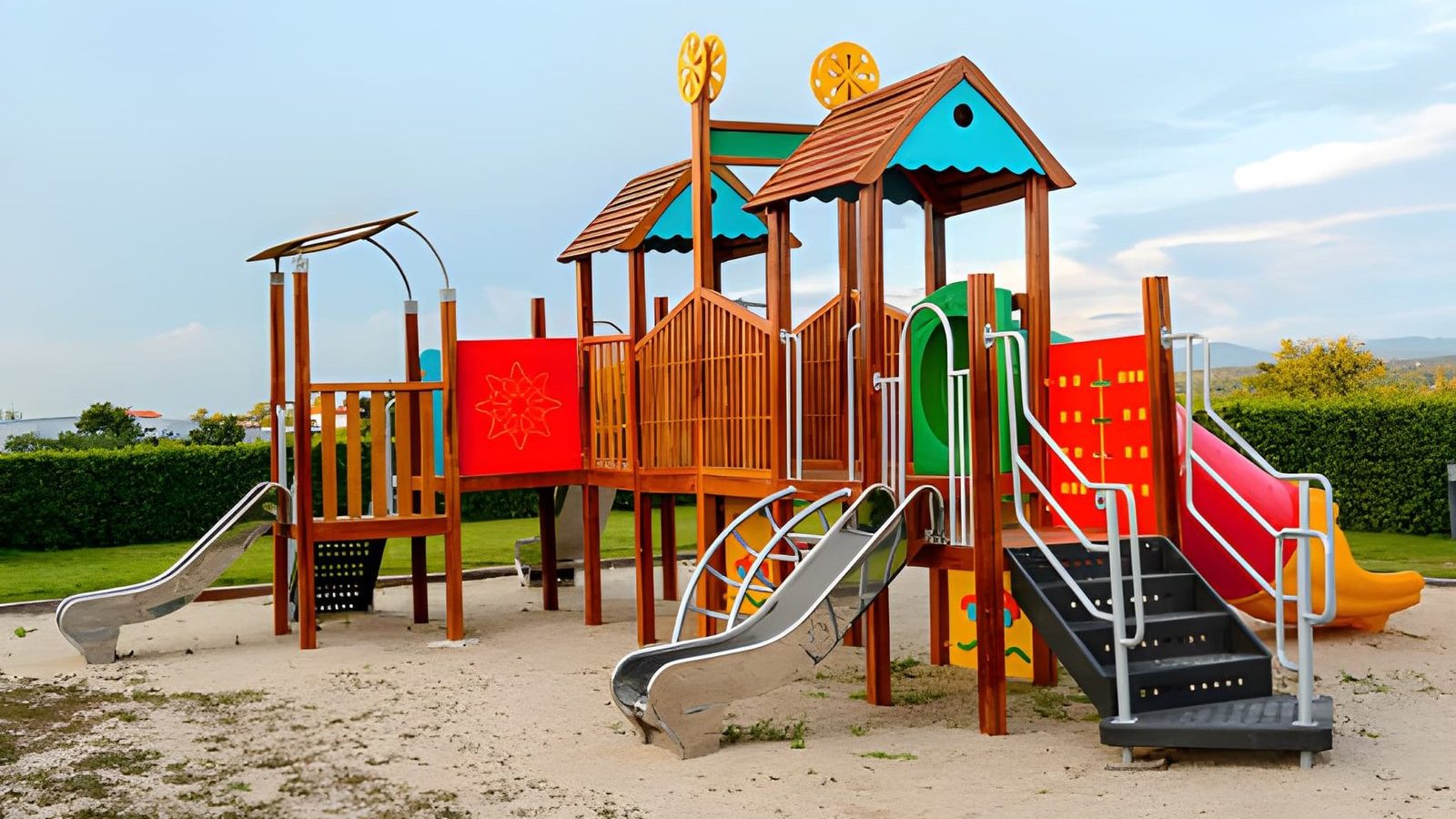
Picture a suburban council playground. Genuine heavy use for a couple of hours after school, a busier stretch on weekends, spread reasonably evenly across the calendar. Now picture your park’s playground during the school holidays: that same intensity of use, all day, every day, for six to eight straight weeks, then almost nothing for the rest of the year. That peak load lands hardest on exactly the equipment guests gravitate to most – slides, swings, and climbing structures, precisely during the months when UV exposure is also at its worst. It’s a brutal combination, and it’s one most equipment simply wasn’t designed to absorb.
Guest turnover piles on a second pressure suburban parks rarely deal with. Almost nobody using your playground lives locally or has any ongoing relationship with the site. That’s not a knock on holidaymakers; it’s just the reality of the business. Equipment needs to tolerate a much higher rate of first-time, unsupervised use than a park where most kids and their parents already know the layout, the rules, and each other.
Materials That Actually Survive Salt Air and Relentless UV
Powder-coated galvanised steel, UV-stabilised HDPE panels and marine-grade fixings are the combination that holds up best in a coastal holiday park environment, and the fixings matter as much as the visible panels.
Most caravan parks and holiday resorts sit within a few kilometres of the coast, which means salt-laden air lands directly on every metal fixing, bolt and footing in the playground, day in, day out. Here’s something worth knowing before you buy: galvanising alone often isn’t enough at this level of exposure. A powder coat finish over galvanised steel adds a genuine second layer of protection, and it’s absolutely worth asking a supplier specifically what corrosion protection is used on fixings and footings, not just on the visible frame everyone can see, because that’s exactly where coastal sites tend to fail first, quietly, out of sight.
For panels, ropes and decking, UV-stabilised high-density polyethylene resists the embrittlement that comes with years of relentless sun far better than standard plastics ever will, and it holds its colour longer too. That matters more than it sounds, because a faded, chalky-looking playground is often a guest’s very first impression of how well a park is maintained overall. Timber can still work beautifully in a themed design, but it needs a species and treatment genuinely suited to constant UV and salt exposure, with drainage engineered into every joint, or it will show decay well ahead of a comparable inland installation.
Designing One Play Space for Toddlers Through Teens
A holiday park typically needs one playground to serve every age from toddlers to teenagers, which means zoning by activity type and challenge level within a single footprint, rather than building separate age-specific areas most sites don’t have room for.
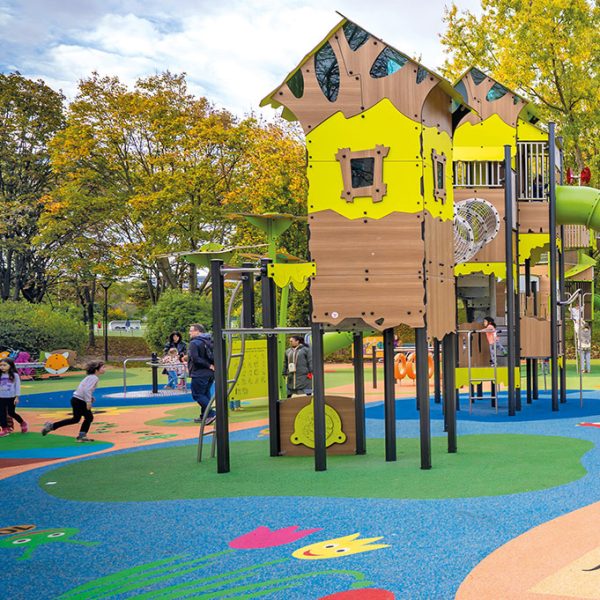
A council can often justify a junior playground on one side of town and a senior one on the other. A caravan park doesn’t have that luxury. You’ve got one footprint, and quite possibly one guest family on any given afternoon with a toddler, a primary schooler and a teenager, all wanting somewhere to go at the same time. The practical answer is zoning within a single space: lower-challenge, enclosed equipment for younger children positioned where it’s easy to keep an eye on from nearby cabins or camp sites, with higher-challenge climbing, balance and calisthenics-style equipment set further out for older kids and teens chasing more of a physical challenge.
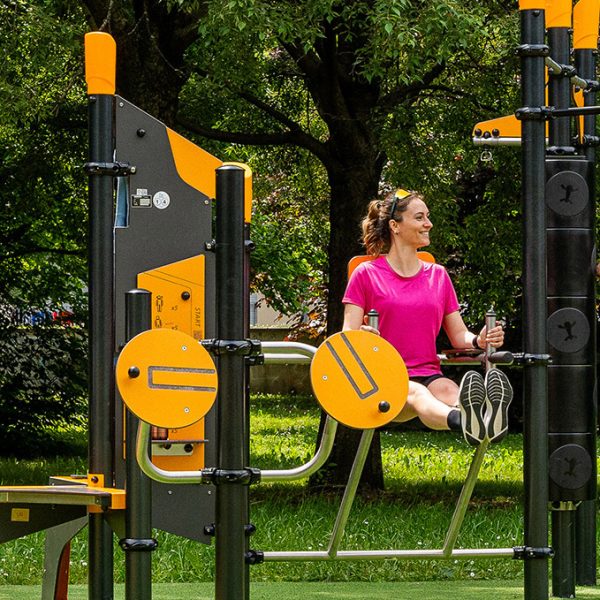
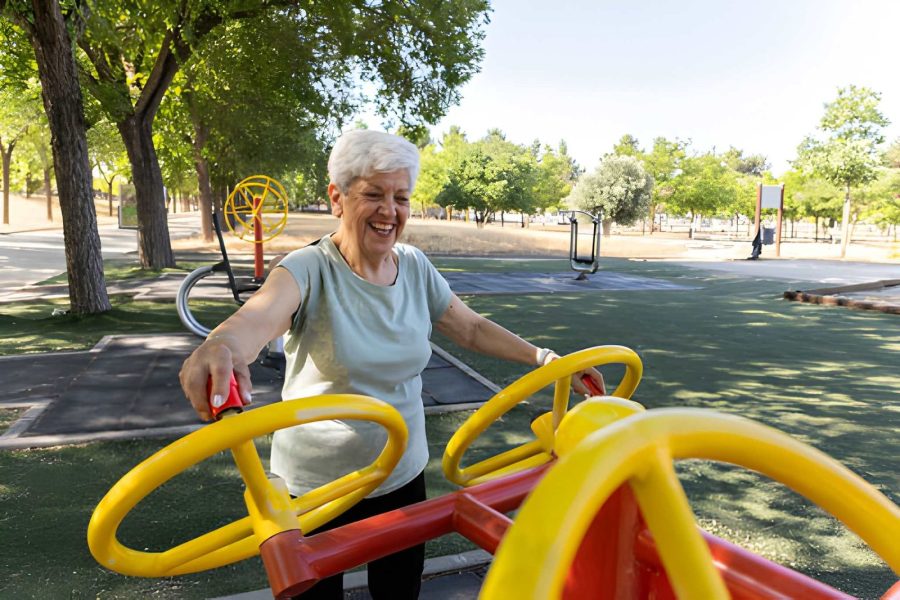
This is also exactly where pairing a themed play area with an adjacent outdoor fitness zone earns its keep. Teenagers who’ve well and truly outgrown a themed playground will still happily use a calisthenics or street workout setup, which keeps the whole family in one part of the park instead of scattering to opposite corners of the site.
Themed and Destination-Style Play as a Guest Experience and Booking Driver
A themed playground gives a holiday park a photographable, memorable point of difference that shows up in guest reviews and booking decisions; not just a place for kids to burn off energy.
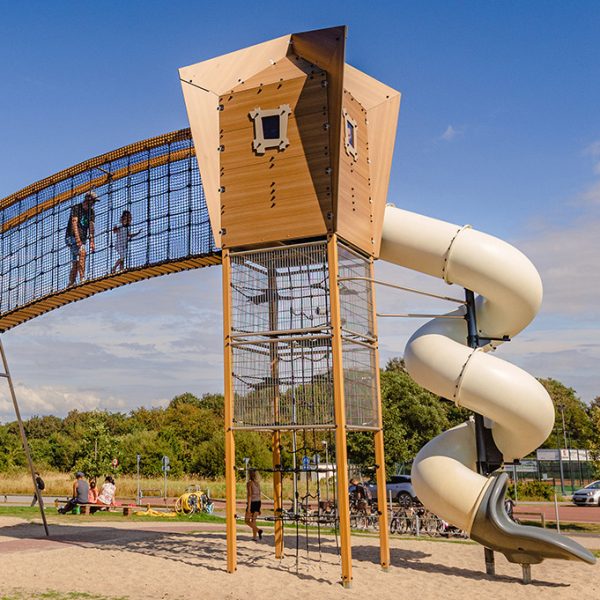
Here’s the reality of how people book these days. Guests choosing between two similar caravan parks increasingly base their decision on photos before they read a single word of the listing. A themed play area, a jungle adventure trail or an underwater-themed play zone, gives a park something genuinely distinctive to put on its website and social channels that a standard swing set never could. Proludic’s themed ranges already cover both directions, built specifically for commercial use, including an underwater Aquatica theme and a jungle Adventure range, designed to be genuinely play-rich rather than just decorative dressing wrapped around standard equipment.
Some parks take it a step further and personalise their equipment with their own branding or local landmarks woven into the design, turning the playground into part of the destination’s identity rather than a generic amenity that happens to be sitting on site. For a holiday park competing on guest experience as much as location, that kind of point of difference can genuinely influence a return booking as much as the view from the cabin does.
Fast-Track Installation Options for the Off-Season Window
Holiday parks generally need playgrounds installed and fully operational within a narrow off-season window, which means project timing and site logistics matter every bit as much as the equipment itself.
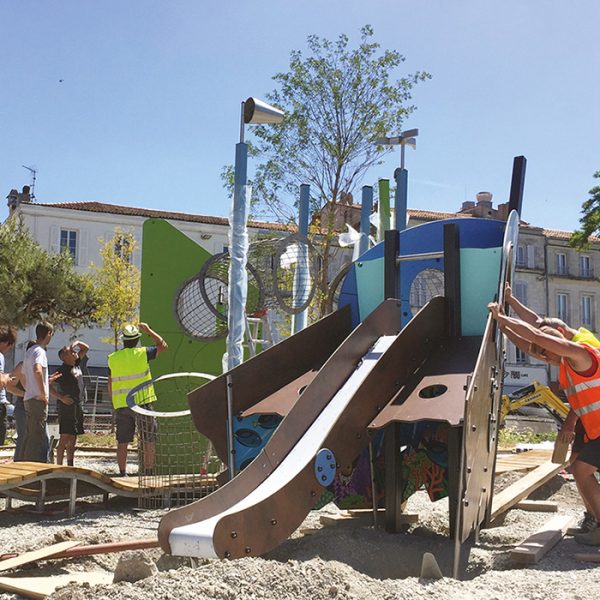
Unlike a council park, which can usually absorb a few weeks of disruption without any real commercial fallout, a holiday park installation has to work around a trading calendar that doesn’t bend for anyone. Most projects get scoped for the shoulder season, after the summer peak and before the next school holiday period hits, with the whole programme planned backward from the date the park needs the space guest-ready. A supplier who manages design, manufacturing, project management, and installation in-house, rather than juggling separate contractors for each stage, tends to compress that timeline meaningfully, simply because there’s one schedule to manage instead of several that all need to line up perfectly.
It’s genuinely worth raising your installation window early in any supplier conversation, before equipment is even finalised, so design and manufacturing lead time can be planned around your actual off-season dates rather than discovering a timing conflict after a design’s already been signed off.
A Short Checklist for Choosing a Playground Supplier
Use this list when comparing suppliers for a caravan park or holiday resort playground project.
- Does the supplier specify corrosion protection on fixings and footings, not just the visible frame?
- Are panels, ropes, and decking UV-stabilised and rated for coastal exposure?
- Can the design zone effectively for a wide age range within your available footprint?
- Does the range include themed or destination-style options that suit your park’s identity and marketing?
- Can equipment be personalised or branded to the park if that’s a priority?
- Does the supplier manage design, manufacturing, and installation in-house, or coordinate multiple contractors?
- Can the installation programme work within your specific off-season trading window?
- What ongoing maintenance and inspection support is available once the equipment is installed?
- Is the equipment certified to the relevant Australian playground safety standard?
Powder-coated galvanised steel with marine-grade fixings, combined with UV-stabilised high-density polyethylene panels and ropes, generally holds up best against salt air and constant sun exposure. Protection on fixings and footings matters as much as the finish on the visible frame.
Timelines depend on the design and site conditions, but most holiday park projects are planned around a shoulder-season installation window, so the playground is guest-ready before the next peak trading period. Raising your available off-season dates early helps a supplier plan design and manufacturing lead times around them.
Yes, with the right zoning. Lower-challenge, enclosed equipment for younger children near supervision points, combined with higher-challenge climbing or calisthenics-style equipment further out for older children and teens, lets one footprint serve a wide age range.
Themed and destination-style ranges are generally positioned similarly to other commercial-grade play equipment of comparable scale and complexity, rather than as a separate premium category. The bigger cost driver is usually the size and challenge level of the structure, not the theming itself.
Themed and destination-style ranges are generally positioned similarly to other commercial-grade play equipment of comparable scale and complexity, rather than as a separate premium category. The bigger cost driver is usually the size and challenge level of the structure, not the theming itself.
The shoulder season, immediately after the summer peak or before the next school holiday period, is generally the best window, since it avoids disrupting peak trading and gives the equipment time to be guest-ready for the next busy period.
Planning a Playground for Your Caravan Park or Resort?
Proludic designs, manufactures, and installs commercial playgrounds for caravan parks, holiday resorts, and tourism operators across Australia, including themed ranges like Aquatica and Adventure built for coastal conditions and peak-season use. Explore our playgrounds for holiday parks and campsites or get in touch to scope your project around your park’s off-season window.
More Tips from Experts

Playground Equipment Maintenance and Safety Inspections: An Australian Council’s Guide to Compliance
Article published on 17 September 2026
Somewhere on your council’s books right now sits a playground that was signed off five, ten, maybe fifteen years ago, and nobody’s given it a second thought since the ribbon was cut. That’s the problem. Sun, salt air, tree roots, and thousands of small hands and feet have been quietly working against it every single...
Outdoor Fitness Equipment for Councils: A Practical Guide to Planning Public Gyms People Actually Use
Article published on 1 September 2026
Drive past enough council parks and you’ll notice the same thing: a brand-new outdoor gym sitting empty while the playground right next to it is full of families. That’s almost never a product problem. It usually comes down to a public fitness area being chosen and specified without much thought for how people will actually...


